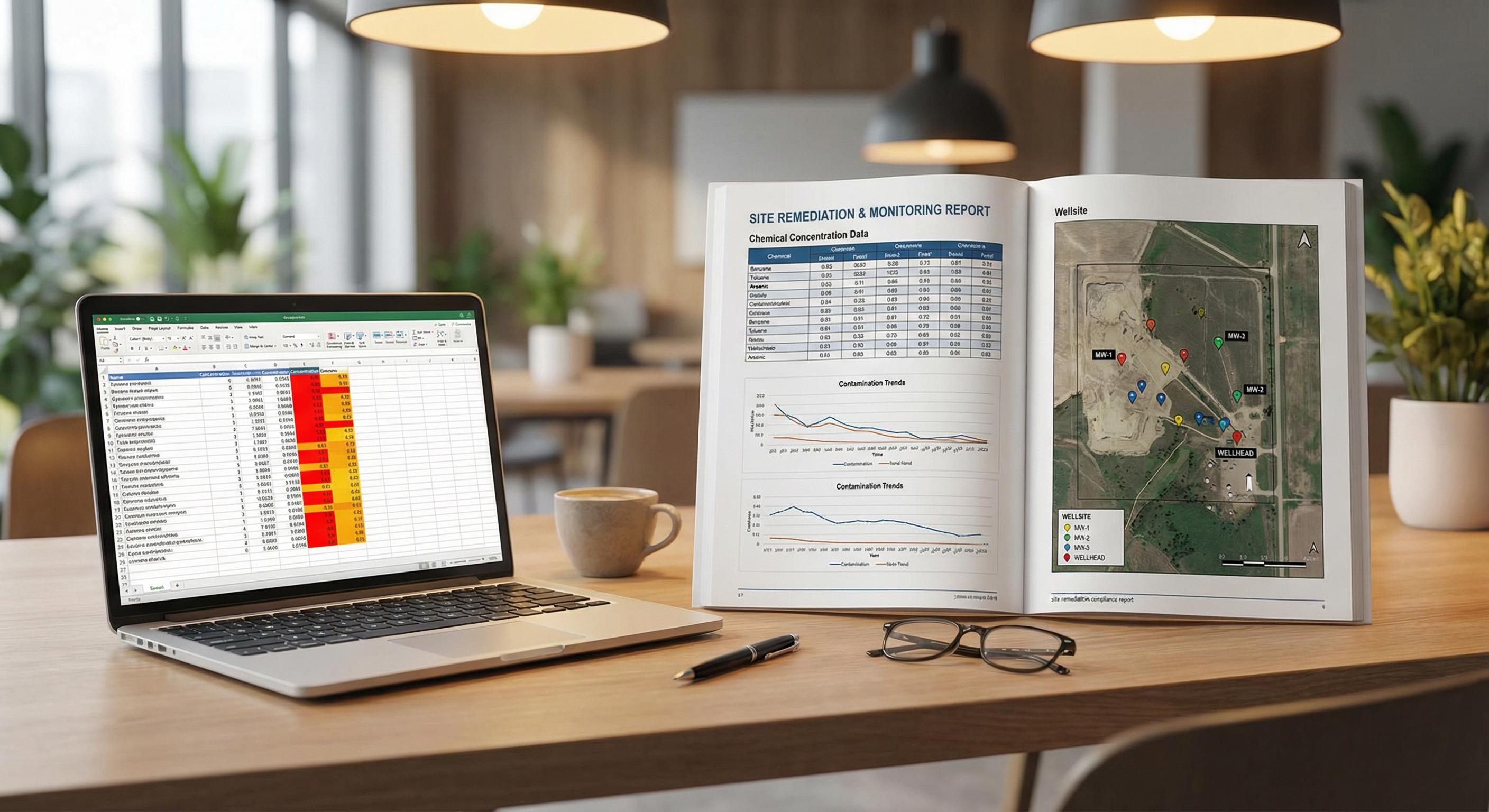
Three soil concentration numbers can govern whether a wellsite closes or stays open: the background concentration, the Tier 1 generic guideline, and the Tier 2A pathway-modified guideline. They look interchangeable on a screening table. They're not. Choosing the wrong one — or applying them in the wrong order — is one of the most common reasons a closure gets bounced back.
The Three Numbers
Alberta's contaminated-site remediation framework, like most Canadian provinces', is built on a three-tier philosophy. The numbers do different jobs:
Background Concentration
What's naturally present in undisturbed soil of similar texture and depth at this site. For metals especially, “clean” soil isn't zero — it's whatever your geology delivers. The background concentration is the floor; you can't reasonably remediate below it, and a site that's at-or-near background by definition isn't contaminated, even if the absolute number is above a generic guideline.
Tier 1
A generic, conservative guideline that assumes “worst plausible” site conditions for the receptor of interest. Tier 1 is the fast lane: if your concentrations are below Tier 1 for the applicable land use and soil texture, you're closed. Tier 1 varies by:
- Land use — agricultural, natural area, residential/parkland, commercial, industrial
- Soil texture — coarse-grained vs. fine-grained
- Receptor — human direct contact, ecological direct contact, livestock, freshwater life via groundwater pathway, etc.
Tier 2A
The same conceptual framework as Tier 1, but with pathway-specific modifications based on actual site conditions. If a Tier 1 receptor pathway doesn't exist at this site (e.g. no freshwater body within 1 km), Tier 2A lets you screen that pathway out. The result is often a less stringent guideline that still defensibly protects every plausible receptor. Tier 2A is where defensible closures happen on sites that exceed Tier 1 on paper but aren't actually causing harm.
How They Interact (And Where Consultants Get It Wrong)
The intended order of operations is:
- Screen against Tier 1. If everything's below Tier 1, close the file.
- For Tier 1 exceedances, screen against site-specific background. If the site concentration is at or below background, no remediation is required — you're not above natural levels.
- For exceedances that are above both Tier 1 and background, evaluate under Tier 2A. Confirm or modify the pathways that drive the Tier 1 number based on actual site conditions. The output is a Tier 2A guideline that's specific to this site.
- If still exceeded, the site needs remediation or a higher-tier risk assessment.
Where this falls apart in practice is usually step 2: site-specific background is treated as one number for the whole site, when it should be a depth-binned, texture-aware statistic. Step 3 falls apart when Tier 2A pathway exclusions are claimed without the supporting site characterization.
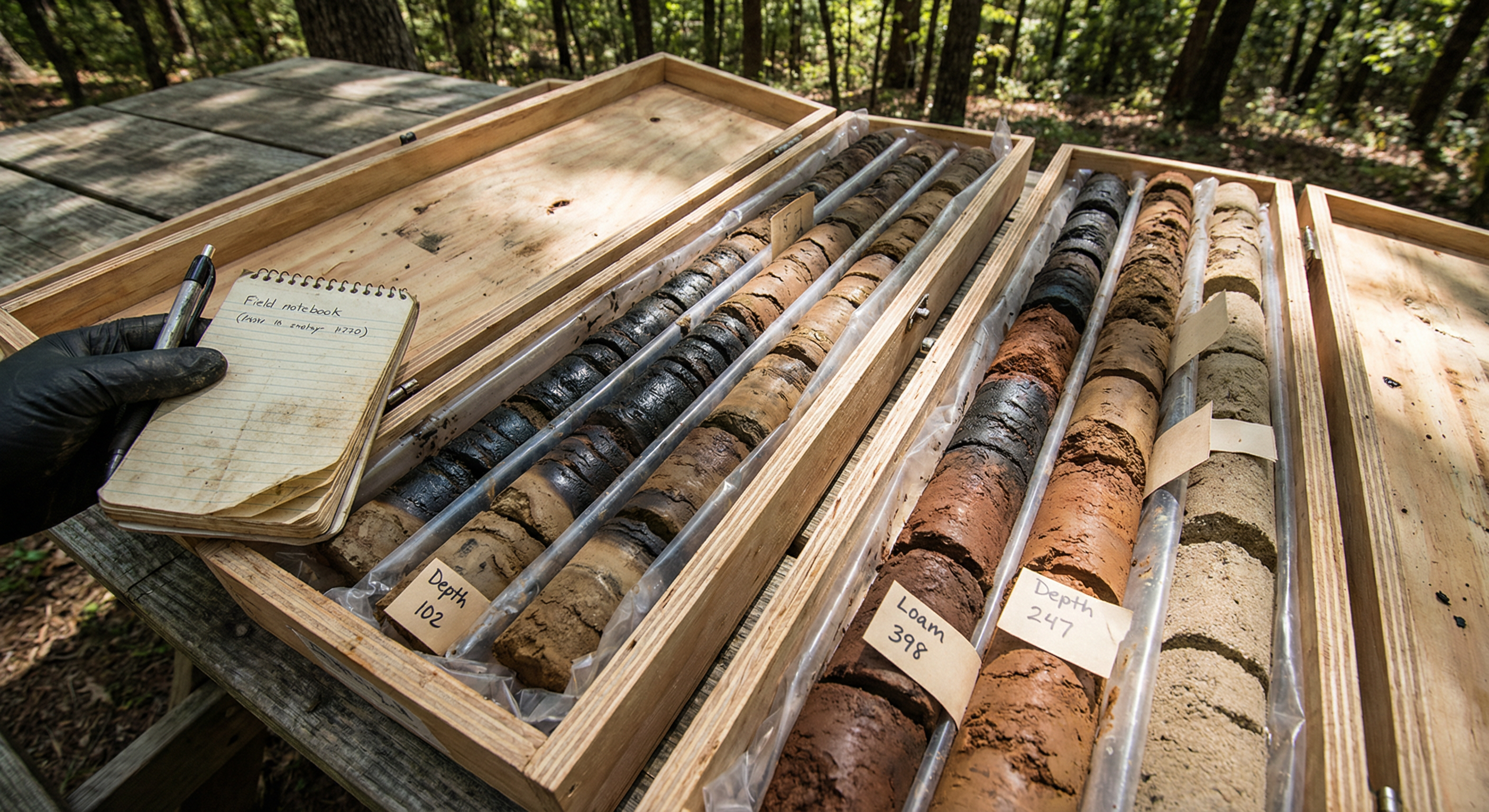 Background isn't a single number. The 0–0.5 m horizon and the 3–5 m horizon have different mineralogy and different natural concentrations. Treating them as one masks real impact and falsely flags clean intervals.
Site-Specific Background, Done Properly
The defensible way to derive a site-specific background is:
- Sample undisturbed reference areas — outside any plausible impact footprint, but on the same site to capture the same geology.
- Stratify by depth bin (e.g. 0–1 m, 1–3 m, 3–5 m, 5+ m) and by soil texture if you see texture variation between samples.
- Compute a percentile-based statistic (P95 is standard) for each depth-bin / texture cell.
- Compare each impact-zone sample to the matching depth-bin / texture cell, not to a site-wide average.
This is exactly what the Site-Specific Background Calibration engine in [GRYD] does. The delta-shift algorithm recalibrates EC and SAR thresholds (the salinity workhorses) by depth bin using P95 of your reference samples. For metals and PHCs, the same depth-bin / texture stratification applies.
Where Tier 2A Pathway Re-Runs Save You
Once background is handled, the remaining exceedances need a Tier 2A evaluation. The pathway logic asks, for each analyte: which receptor pathway drives the Tier 1 number, and does that pathway actually apply here?
An example: benzene's Tier 1 in fine-grained soil is governed in part by the freshwater-life-via-groundwater pathway. If the nearest freshwater body is 8 km away and the groundwater gradient is moving away from it, you can defensibly remove that pathway from the Tier 2A calculation. The remaining receptor pathways (human direct contact, ecological direct contact, etc.) might give you a benzene guideline 5× or 10× higher than Tier 1.
The catch is that you have to evaluate this analyte by analyte, pathway by pathway. With 30–50 parameters on a typical Phase II site, that's a lot of manual table work. [GRYD]'s Tier 2A pack supports pathway scenario re-runs on a locked dataset — you toggle which pathways apply, and the screening re-runs across the whole analyte list in seconds. Each re-run gets a stamped audit-trail entry, so you can defend exactly which pathways were active when you reached your conclusion.
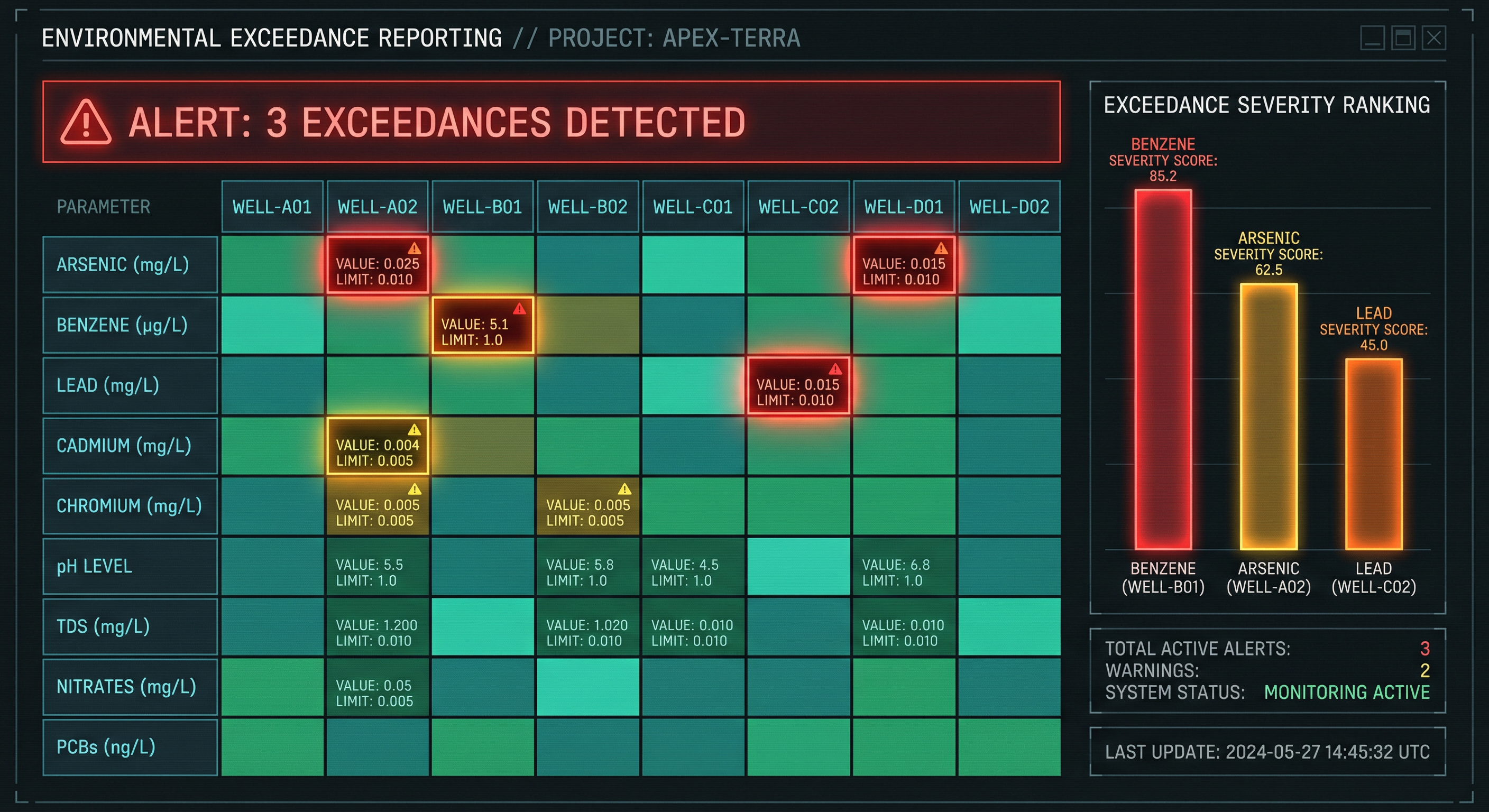 Pathway scenario re-runs on a committed dataset. Same data, different pathway assumptions, two stamped runs in the audit trail.
What This Looks Like in Practice
A typical closure path on a real wellsite using all three numbers:
- Tier 1 screening — flags exceedances for benzene, F2, F3, and arsenic across three monitoring wells.
- Background comparison — arsenic exceedances clear (site is at depth-bin P95 background for As in fine-grained till).
- Tier 2A re-run with pathway modifications — freshwater pathway dropped (no receptor within 1 km), gradient confirmed. Benzene and F2 now below the pathway-modified Tier 2A. F3 still exceeded.
- Targeted remediation — excavation volume calculator gives 480 m³ for F3 above the Tier 2A threshold. Remediation scope is defensible and cost-bounded.
Without the three-tier framework, the path of least resistance is to overbid the excavation to the Tier 1 footprint — often 3× or 4× the actual remediation scope. That's wasted client money and unnecessary disturbance.
A Note on Other Provinces
The conceptual framework is similar across most Canadian provinces — Background → Generic Screening → Pathway-Modified Screening → Risk Assessment. The specific numbers, pathway definitions, and terminology differ. [GRYD] ships AB Tier 1 and Tier 2A today; BC, SK, MB, ON, QC, NWT, and YT packs are on the near-term roadmap, alongside US EPA / California / Texas / New York for cross-border work.
See How [GRYD] Handles Your Tier 2A Pathways
Pathway scenario re-runs, depth-bin background, and audit-trail stamping on a single committed dataset.
Explore Features