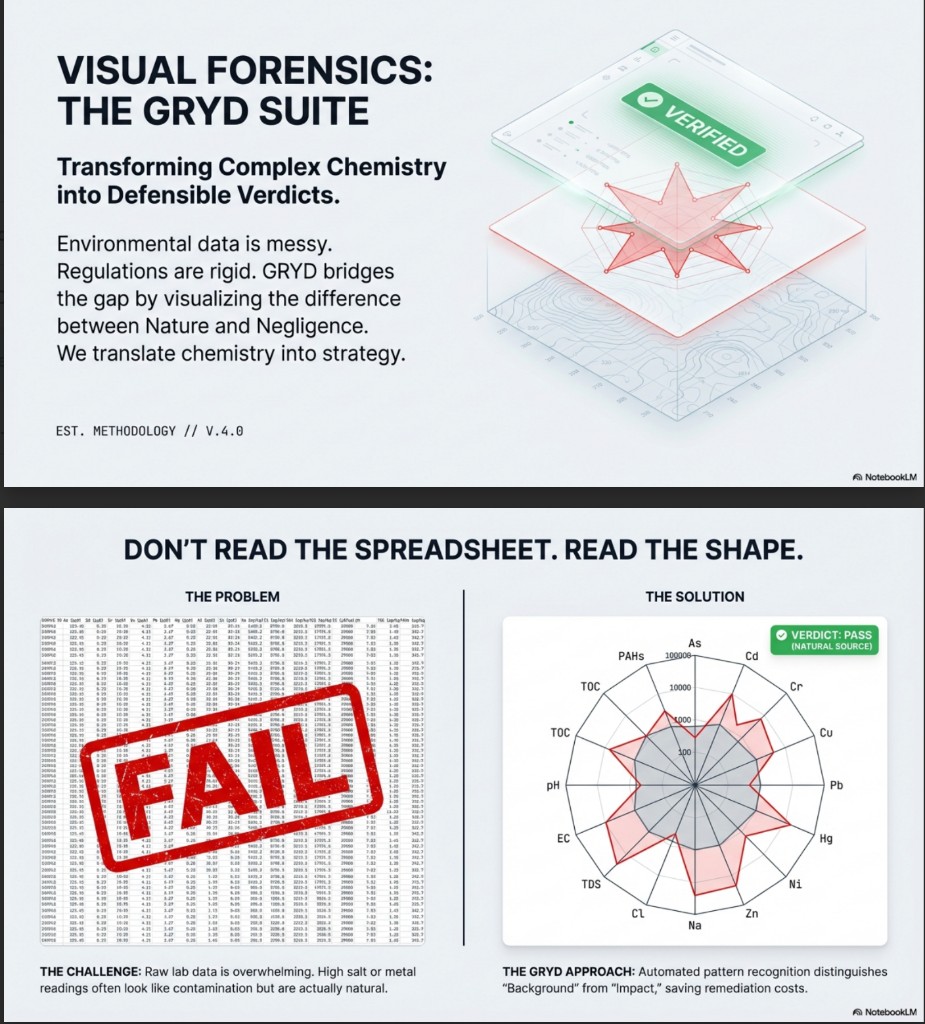
You have a groundwater dataset and a question about its origin. Different diagrams answer different questions, and reaching for the wrong one is the most common reason a forensic interpretation gets pushed back. Here's a working decision tree for the most-used diagrams — what each one is good for, what it isn't, and where they sit in a defensible forensic narrative.
Start With the Question
Before you open any diagram, write down the question you're actually trying to answer. The five most common ones in environmental forensic work:
- What kind of water is this? — classification by ion chemistry
- Where did the dissolved solids come from? — source identification (rock weathering vs. evaporation vs. anthropogenic input)
- Is this irrigation-grade water? — suitability for agricultural use
- What's the source of this contamination? — forensic discrimination of refined product vs. crude, biogenic vs. anthropogenic, etc.
- How does this sample compare to a reference? — multi-sample ion comparison
Each diagram is built for one or two of these questions. Pick on purpose.
Piper Diagram — Classification
Use it when: you want to classify groundwater type by its dominant cations and anions, and visually distinguish between samples in the dataset.
The Piper plots cation triangles (Ca, Mg, Na+K) and anion triangles (HCO₃, SO₄, Cl) and projects them into a central diamond. Different parts of the diamond correspond to different hydrogeochemical water types — Ca-HCO₃ (recently recharged shallow groundwater), Na-Cl (mature or impacted groundwater), Ca-SO₄ (gypsum-dissolution waters), and so on.
Strength: One chart, every sample, clear water-type clusters.
Limit: Piper compresses absolute concentrations into percentages. Two samples can plot identically and have wildly different total dissolved solids. Always read it alongside a Schoeller or a TDS column.
Stiff Diagram — Visual Ion Signature
Use it when: you want a per-sample “fingerprint” that captures both ion ratios and absolute concentrations.
A Stiff diagram is a polygon, one per sample, with cation concentrations plotted on the left and anion concentrations on the right. The shape is the fingerprint. Two samples with similar shapes have similar chemistry; two samples with the same Piper position but different Stiff polygon sizes have the same water type but different concentrations.
Strength: Carries concentration information that Piper loses. Excellent for visually showing “these wells are the same water, just diluted differently.”
Limit: Doesn't scale visually past 10–15 samples — the page gets cluttered. Use it for a focused subset, not the whole dataset.
Schoeller Diagram — Multi-Sample Ion Comparison
Use it when: you want to compare absolute ion concentrations across many samples on one chart.
Schoeller is a semi-log plot of ion concentration (y-axis) against ion species (x-axis). Each sample is a line. Parallel lines mean similar chemistry at different concentrations. Crossed lines mean different ion ratios.
Strength: Carries concentration. Good for showing dilution trends, mixing relationships, or evolution along a flow path.
Limit: Reads as a forest of lines if you have too many samples. Group samples by depth, well, or sampling round before plotting.
Wilcox Diagram — Irrigation Suitability
Use it when: the question is whether this water is appropriate for agricultural irrigation.
Wilcox plots EC (salinity hazard) against SAR (sodium hazard) and divides the plane into classes (C1S1 through C4S4). Each class corresponds to an irrigation suitability rating.
Strength: Specifically built for irrigation decisions. Common reference for agricultural Tier 1 / Tier 2A salinity work.
Limit: Designed for non-impacted irrigation water. For impacted water (produced water, brine release, road-salt impact), Wilcox tells you the irrigation hazard but not the source — pair with the Salt Fingerprint or Brine Meter for that.
Gibbs Diagram — Geochemical Process Identification
Use it when: the question is about where the dissolved solids came from at a regional or aquifer scale — specifically, are they from rock weathering, evaporation/crystallization, or atmospheric precipitation?
Gibbs plots TDS against (Na/(Na+Ca)) and (Cl/(Cl+HCO₃)) to separate samples into the three classic process domains.
Strength: Useful for distinguishing between natural baseline chemistry and an anthropogenic overprint. If a sample plots well outside the natural fields, something non-natural is contributing.
Limit: Designed for surface and shallow groundwater at regional scale. Less useful inside a contamination plume; more useful for the reference samples around it.
PAH Cross-Plot & Source Discriminator — Contamination Forensics
Use them when: the question is “what kind of contamination is this?” — refined product vs. crude, pyrogenic (combustion) vs. petrogenic (petroleum) PAH, biogenic vs. anthropogenic methane, etc.
A PAH Cross-Plot puts diagnostic ratios on the axes (e.g. Phenanthrene/Anthracene vs. Fluoranthene/Pyrene). Different combustion vs. petroleum sources plot in known regions of the diagram. The Source Discriminator is a closely related diagram that combines several ratios into a multi-axis fingerprint.
Strength: The most direct forensic discriminator available for hydrocarbon impacts — speaks to source identification, not just impact extent.
Limit: The ratios assume the contamination hasn't been heavily weathered. Heavily degraded plumes shift in ways that look like a different source. Pair with PHC Chromatogram analysis for weathering context.
Decay Tracker — Natural Attenuation
Use it when: the question is whether reductive dechlorination is going to completion in a chlorinated solvent plume.
The Decay Tracker stacks the molar contributions of PCE, TCE, cis-DCE, VC, and ethene over time per monitoring well, so you can read the chain. Covered in detail in the Decay Tracker blog post.
A Decision Tree
Here's the tree we use internally when picking the right diagram for a forensic question. It's not exhaustive — the Visual Forensics suite ships 25+ diagrams — but it covers most cases.
- “What kind of water is this?” → Piper (start), then Stiff for concentration, then Schoeller for inter-sample comparison
- “Where do the dissolved solids come from?” → Gibbs (natural baseline) → if outside natural fields, move to source-specific diagrams
- “Is this irrigation water?” → Wilcox (suitability) + Salt Fingerprint (source if non-natural)
- “Is the salt from brine, road salt, or fertilizer?” → Salt Fingerprint → Brine Meter (if produced-water suspected) → Fertilizer Finder
- “What's the hydrocarbon source?” → PAH Cross-Plot + Source Discriminator + PHC Chromatogram
- “Is natural attenuation working?” → Decay Tracker (chlorinated) or PHC Chromatogram + geochemical indicators (PHC)
- “How does my site compare across depth?” → Depth Doctor + Depth Profile + Geology Matcher
The Defensibility Loop
A forensic interpretation is defensible when three things are true: the data the interpretation is based on is preserved and reproducible, the analytical method (the diagram and its inputs) is documented, and the chain of reasoning from data to conclusion is auditable.
Every diagram in the [GRYD] Visual Forensics suite is generated against the active run's locked data snapshot. The diagram itself is stamped with the run ID, the regulatory pack version, and the input columns. If someone asks “what data was this Piper based on?” eighteen months later, you re-open the run and the diagram regenerates against the exact same data. That's the loop — data → diagram → interpretation → audit-trail entry → future reproducibility.
If you'd rather have an extra set of eyes on the forensic narrative, open the Ask GRYD panel and ask “does the Piper classification at MW-03 support the conclusion that this is impacted by produced water?” The agent will read the active forensic diagrams and respond with a grounded interpretation. Useful for sanity-checking your own read.
See the Visual Forensics Suite in Action
25+ specialty diagrams, all grounded in your data, all publication-ready.
Explore Features